Our Blog

How to Govern Multi-Model AI Ecosystems
One model is easy to govern.
Twenty models is where EA becomes essential.
As enterprises adopt foundation models, domain models, small specialist models, and embedded vendor models, governance can’t be an afterthought.
You can’t bolt control onto a system that’s already fragmented.
You need governance that scales with intelligence.
And that’s a different discipline entirely.
What Effective Governance Looks Like
Here’s what effective governance looks like when you’re managing many models across the enterprise:
1) Unified Policy Layer
Policies shouldn’t live in documents.
They should live in platforms.
Access, usage constraints, compliance rules, and redlines apply consistently across every model - internal or external.
2) Model Contracts
Every model exposes a contract that defines:
- allowed inputs
- expected outputs
- performance thresholds
- risk posture
- escalation paths
This makes AI predictable, testable, and interchangeable.
3) End-to-End Lineage
It’s not enough to track the model.
You track the chain:
Data → Training → Fine-tuning → Deployment → Decisions → Business impact.
This is the backbone of trust, audit, and accountability.
4) Autonomous Guardrails
Governance has to run in real time.
Not in reviews.
Not in committees.
Guardrails evaluate risk, detect anomalies, block unsafe operations, and flag drifts automatically — as the model executes.
5) Model Routing Governance
When multiple models can fulfill a task, governance decides who gets picked.
Based on:
- data sensitivity
- accuracy requirements
- cost ceilings
- latency needs
- compliance constraints
It’s governance by logic, not by opinion.
6) Vendor Model Oversight
Every SaaS tool now hides a model inside it.
EA must govern:
- What data it sees
- How it reasons
- What actions it can trigger
- How its outputs flow into critical systems
This is the new blind spot in enterprise risk.
7) KPI Framework for AI Value
Governance isn’t about slowing down.
It’s about proving value.
Track KPIs like:
- decision accuracy
- cost-per-inference
- adoption rate
- model freshness
- business lift
If you don’t measure it, you can’t scale it.
The Shift
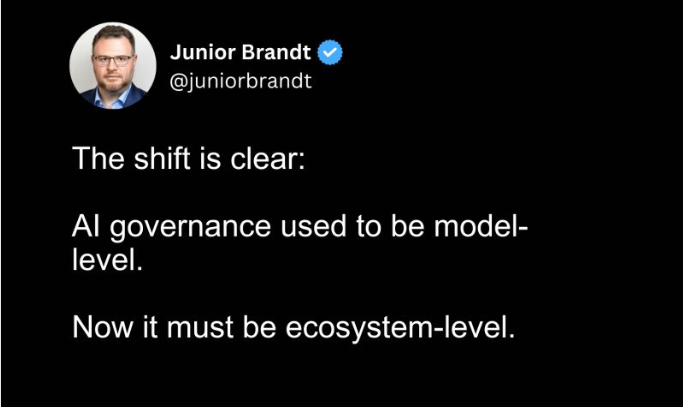
The shift is clear:
AI governance used to be model-level.
Now it must be ecosystem-level.
Because in a multi-model world, risk doesn’t come from a single model misbehaving — it comes from models interacting, compounding, and amplifying each other.
EA is the only discipline designed to govern that complexity.
Related Articles