Our Blog

The “Cost Per Capability” Framework for AI
Introduction: The Wrong Metric Is Costing You More Than Money
Most enterprises still measure AI the old way:
- Cost per model
- Cost per token
- Cost per workload
That approach might have worked when AI meant one model, one use case.
But in today’s reality—multi-model, multi-agent, multi-capability architectures—this view collapses fast.
Why?
Because models don’t create value.
Capabilities do.
Classification.
Summarization.
Forecasting.
Retrieval.
Sentiment analysis.
Recommendation.
Reasoning.
These are the true units of business value—and each has a very different cost and ROI profile.
The smartest FinOps teams are no longer asking:
“How much did our model cost?”
They are asking:
“What is the cost of the capability this AI delivers?”
That mindset shift changes everything.
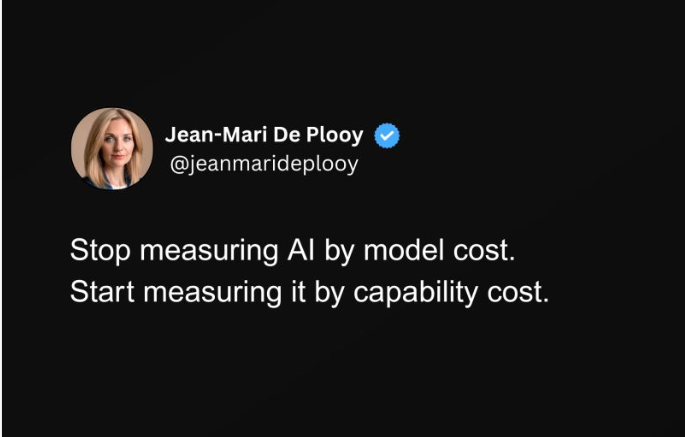
From Cost Per Model to Cost Per Capability
Old World Thinking
- Optimize model selection
- Negotiate token pricing
- Track spend by vendor
Modern AI Economics
- Optimize business capabilities
- Route intelligently across models and systems
- Measure cost where value is actually created
This is the foundation of the Cost Per Capability Framework.
1. Map Capabilities, Not Models
Every AI task should be tied to a business capability, not a model name.
Instead of:
- “GPT-4 is used here”
- “Claude handles this workflow”
Think:
- “Customer sentiment detection”
- “Contract risk classification”
- “Demand forecasting”
- “Knowledge retrieval”
This immediately:
- Breaks vendor lock-in
- Enables architectural flexibility
- Shifts thinking from tech to outcomes
Models become interchangeable.
Capabilities become strategic.
2. Route Each Capability to the Right Engine
A larger model is not automatically better.
Depending on the capability, the optimal solution might be:
- A small specialist model
- A domain-trained model
- A rule-based system
- Retrieval without generation
- A hybrid pipeline
Capability ≠ model size
Using a frontier model for every task is one of the fastest ways to inflate AI spend with minimal value gain.
3. Compare Cost vs. Value at the Capability Layer
Not all capabilities are equal.
Some deliver direct business value:
- Risk scoring
- Fraud detection
- Revenue forecasting
Others generate convenience, not outcomes:
- Ad-hoc summarization
- Exploratory chat
- Low-impact content generation
FinOps maturity means:
- Funding high-value capabilities
- Constraining or throttling low-impact ones
- Making trade-offs visible to the business
This is where AI stops being a science experiment and starts being a portfolio.
4. Optimize Performance Per Capability
When costs rise, the mistake is to “optimize the model.”
The correct move is to optimize the capability.
Examples:
- Reduce context window sizes
- Introduce intelligent caching
- Improve retrieval discipline
- Reduce unnecessary agent loops
- Route simple tasks to cheaper paths
This is where 30–70% cost reductions typically appear—without harming business outcomes.
5. Scale Only What Drives ROI
A powerful capability with weak ROI should not scale.
Even if:
- The model is impressive
- The demo is popular
- The tech team loves it
AI cost discipline starts with business logic, not technical enthusiasm.
If a capability doesn’t move:
- Revenue
- Risk
- Efficiency
- Customer experience
It should not be multiplied across the enterprise.
The Core Shift That Changes Everything
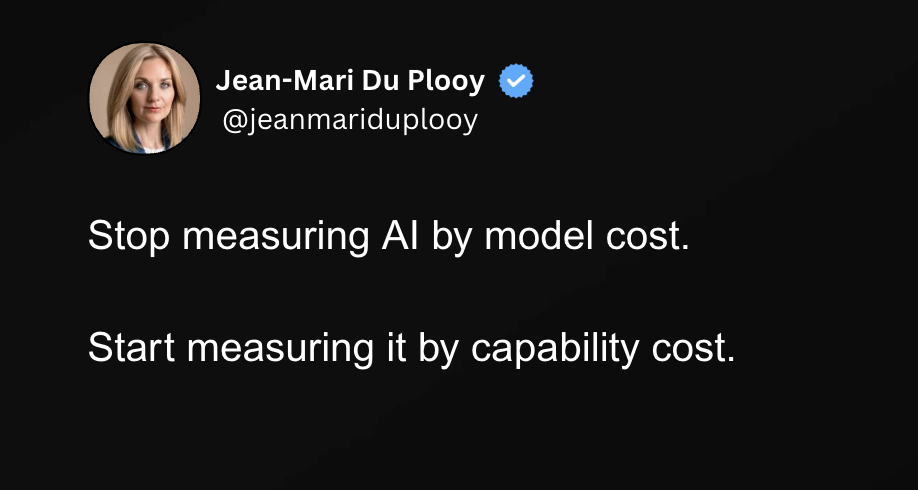
Old world: Cost per model
Modern world: Cost per capability
This shift:
- Breaks the cycle of overuse
- Prevents runaway AI spend
- Eliminates hype-driven scaling
And most importantly, it places AI economics exactly where they belong:
At the intersection of cost, architecture, and business value.
Final Thought: Operationalizing AI, Not Just Optimizing It
Enterprises that adopt the Cost Per Capability Framework don’t just make AI cheaper.
They make it:
- Governable
- Scalable
- Strategically aligned
They stop managing AI as a technology expense—and start running it as a business capability portfolio.
That’s the difference between using AI and operationalizing it.
Related Articles