Our Blog

The “Cost Per Capability” Framework for AI

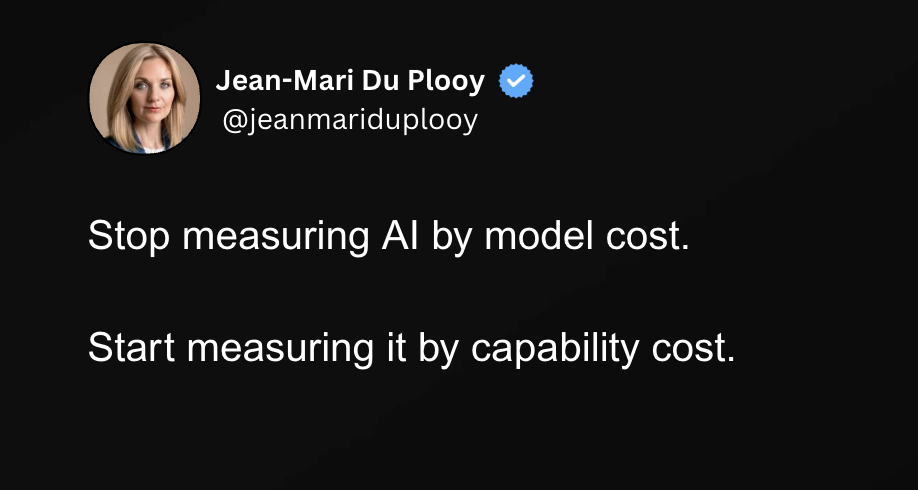
Stop measuring AI by model cost.
Start measuring it by capability cost.
Traditional AI Cost Measurement
Most enterprises still track AI spend the old way:
- cost per model
- cost per token
- cost per workload
But in a multi-model, multi-agent environment, this view collapses fast.
Because models don’t drive value.
Capabilities do.
Capabilities as the Units of Value
- Classification.
- Summarization.
- Forecasting.
- Retrieval.
- Sentiment.
- Recommendation.
- Reasoning.
These are the units of value.
And they each have a dramatically different cost profile.
How FinOps Teams Think Differently
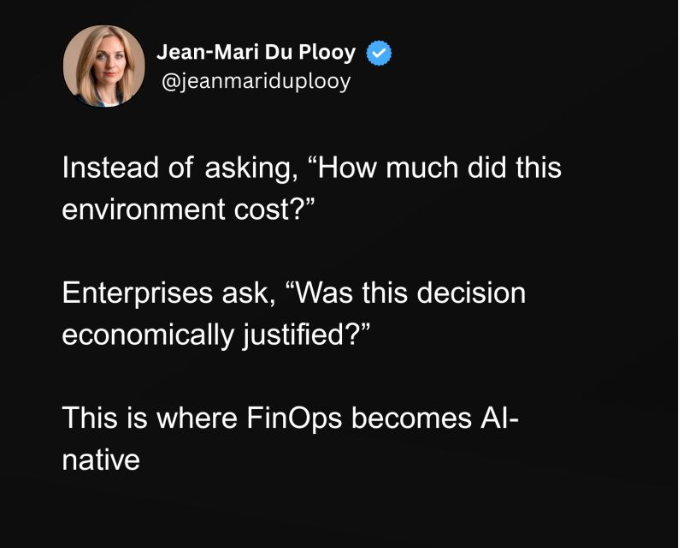
The smartest FinOps teams aren’t asking:
“How much did our model cost?”
They ask:
“What’s the cost of the capability this model delivers?”
Here’s how the Cost Per Capability framework works:
1) Map capabilities, not models
Every AI task is tied to a business capability - not a model name.
This frees you from vendor lock-in and model-centric thinking.
2) Route capabilities to the right model
A large model is not always the best model.
Sometimes the best capability comes from:
- a small specialist model
- a domain model
- a rule-based engine
- or retrieval without generation
Capability ≠ model size.
3) Compare cost vs. value at the capability layer
Some capabilities are high value (risk scoring).
Some are high noise (ad-hoc summarization).
FinOps prioritizes what actually matters.
4) Optimize performance per capability
When costs rise, you don’t tune the model — you tune the capability:
- smaller context windows
- cheaper routing
- more caching
- retrieval discipline
- fewer agent loops
This is where cost drops 30–70%.
5) Scale only the capabilities that drive ROI
A capability with weak ROI shouldn’t scale - even if the model is powerful.
AI cost discipline starts with business logic, not tech enthusiasm.
The Shift
Old world: cost per model
Modern world: cost per capability
This breaks the cycle of overuse, overspend, and over-hype.
And it puts AI economics exactly where they belong:
at the intersection of cost, architecture, and business value.
Conclusion
Enterprises that adopt this framework don’t just optimize AI — they operationalize it.
Related Articles