Our Blog

The Modern Finance Mandate
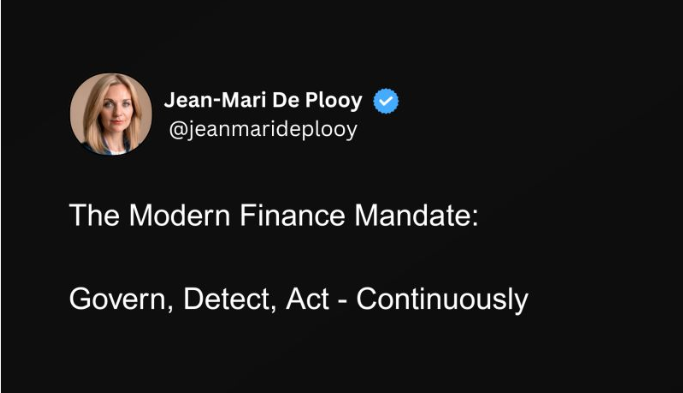
The Modern Finance Mandate:
Govern, Detect, Act - Continuously
When GRC and ESG are embedded into financial operations, three transformations occur:
1. Governance moves from static to systemic
Policies are no longer PDFs on a shelf.
They become machine-readable rules embedded directly into workflows.
Identity, access, entitlements, financial approvals, data lineage — all enforced automatically.
The result:
Compliance becomes an architectural feature, not an afterthought.
2. Risk becomes a real-time signal, not a quarterly update
AI-driven anomaly detection spots abnormal patterns instantly:
- unusual spend
- suspicious vendor activity
- gaps in controls
- ESG scoring deviations
- inconsistencies in financial statements
Instead of reacting to risk, finance teams anticipate it.
3. ESG becomes financially material
Sustainability metrics finally integrate with revenue, cost, margin, and capital allocation.
Enterprises can answer questions that were previously impossible:
- What is the carbon cost of running this product line?
- How does supplier risk impact EBITDA?
- What sustainability improvements generate the highest financial ROI?
- How does transparency impact investor confidence?
ESG stops being a checkbox.
It becomes a driver of strategy, resilience, and brand value.
The Architecture Behind Integrated GRC & ESG
To get this right, enterprise finance requires a connected foundation:
- Unified data models for financial, operational, and sustainability data
- Real-time integration between ERP, risk engines, ESG systems, and analytics
- AI/ML models to detect anomalies and assess emerging risk
- Policy-as-code frameworks for automated compliance
- Semantic data layers to ensure consistency of meaning across domains
- Continuous reporting pipelines for regulators, auditors, and investors
Related Articles